Christine Sun Kim In-Gallery Resources
Discover resources designed to support your visit to Christine Sun Kim: All Day All Night. For more information about accessibility, visit our accessibility page.
ASL Videos
Christine Sun Kim: ALL DAY ALL NIGHT ASL Family Activity Guide

Hello, my name is Ntxhee Sua Vang and I am a Hmong Deaf woman with long black hair. I wear black glasses with gold frames. I am wearing black clothes with a green jade necklace and silver hoop earrings and am in front of a grey background.
I am here to take you through the family activity guide for the exhibition Christine Sun Kim: All Day All Night.
Family activity guides are a resource for families to explore Walker Art Center (WAC) exhibitions and gain a deeper understanding of the artwork on display.
This guide will focus on 4 artworks in the exhibition. For each artwork we have created an activity to help you reflect on your own perspective, as well as learn more about CK’s ideas behind her artwork.
Christine Sun Kim (CK) was born in California and now lives in Berlin, Germany. CK’s art asks us to think about sound and how we communicate with each other. She often makes artwork that gets creative with her native language, American Sign Language, known as ASL. In ASL, people communicate through signing, which involves hand, face, and body movements. No matter whether your language involves speaking or signing, she’ll get you thinking about it in new ways!
Gallery 1: Explore the Space Around Sound
In this exhibition, you’ll find artworks with drawings of music notes and symbols. The artist experiments with the shapes of the staff, the long lines and spaces where a composer places musical notes. The notes near the top have a higher pitch, and they get lower toward the bottom.
Try it out! Draw a staff for music notes. A traditional staff has five straight lines, but you can use as many as you want. The lines don’t have to be straight or horizontal—they can go up and down, backwards, or in a circle.
How do you think a musician would play notes on a staff with straight lines? What about with circular lines? How would you show the mood or melody of your composition? What name could you give your drawing?
Find two videos in gallery 2—The name of the art is called “Tables and Windows.”
CK and artist Thomas Mader use ASL to sign each prompt together. They play a game! One stands behind the other, then reaches their arms around to make it look like the person in front is signing.
You may notice that a lot of the description for these signs happens using the face. In ASL, facial expressions communicate specific meanings. So, as you’re watching the videos, pay attention both to what one artist does with their arms and what the other one is doing with their face!
Try it out! Choose an everyday object like a brush, toothbrush, shoe, or lamp. Next, draw your object over and over—but give it a different personality every time.
For example, a toothbrush. The first one is drawn normal. Then draw the toothbrush happy, shiny, or sad. Imagine one is on fire it’s so mad!
Keep drawing them with different personalities. How does your object change?
In Gallery 3, you’ll find a group of artworks inspired by the sign for the word “echo.”
This sign is made with one hand that stays still, while the other moves to make a shape like a ball bouncing off a wall. It shows the idea of how sound can bounce off a surface.
CK uses the titles of these works to call out different types of echoes: long ones, small ones. The artist has described repetition and echoes as part of “a very Deaf experience.”
When she communicates with a hearing person who doesn’t know ASL, she works with an interpreter. Her interpreter uses spoken language to repeat what she says in ASL to the hearing person. Then, the interpreter uses ASL to repeat that person’s response back to CK. From one person to the other and back, from one language to another, the artist has compared this communication to an echo.
For short conversations, or small echoes, it’s fine. But longer conversations, longer echoes, and repetitions are a part of the Deaf experience that can’t be avoided. Is that clear?
Now it’s your turn to sketch! CK has asked, “if you were to throw happiness as an emotion and it were to bounce off of something, what would that sound like or what does that look like?”
Now it’s your turn to sketch! What would it look like to throw happiness?
Look for an artwork on the floor called, “Oh Me Oh My“.
In ASL, “me” is signed with a finger pointing to the chest. “My” is signed with a palm against the chest.
Now you can sign “me” and “my”! Try it!
Do you see the star shapes on the floor? Sign “me” by tapping your finger on your chest and sign “my” by touching your palm to your chest. Sign “me” when you see a shape that says “finger” and sign “my” when you see a shape that says “palm”.
Did you notice the lines surrounding the star shapes? CK added these lines to show the movement of a hand slapping a person’s chest, or, in this case, the gallery floor.
This family activity guide, available in ASL, English, Hmong, Somali, and Spanish, accompanies the exhibition Christine Sun Kim: All Day All Night, on view at the Walker Art Center, March 27–August 30, 2026.
Educational materials produced by the Whitney Museum of American Art, New York, in partnership with Christine Sun Kim were adapted for this guide.
Thank you for watching the Christine Sun Kim: All Day All Night family activity guide in ASL. Goodbye!
Christine Sun Kim on Too Possessive for Score

I often work in seriality, so different iterations are series. If I ask and think about a question, I typically do create ten different answers, depending on context, depending on hypotheticals, depending on solutions, all these different perspectives. So these are a few drawings that I have. They’re small in size. They were created in 2015. One is entitled Too Possessive for Score. Maybe it’s a comment on people in my life or people that I worked with, interpreters included in that. Sometimes they kind of control or want to take over. You’ll see in the score lines, one note is quite large. It’s like it wants to be a little bit more, like maybe it wants to take over in that note. And the other one is entitled Almost a Score, almost as if they can deceive me or fool me. It looks like it’s a score. But then as I look closer, I feel like, no, it’s actually just a long musical stretched out note, as a score. And I sometimes feel like my voice when I work with other individuals who are maybe expressing my voice that sometimes it really depends on their personality, how big their ego is. Maybe they have their own agenda, and that kind of takes over and invades my own space. It’s like I have my own voice, but somehow their voice is deceiving and taking over. It’s that relationship there.
Christine Sun Kim on Too Much Future

In 2018, Jennie Goldstein, the curator here at the Whitney, reached out to me and offered to do the billboard outside the High Line.
So the 2018 Whitney billboard that I had was titled Too Much Future. And this is the sign for “future”. So if I line-draw that movement, I pictured thickening that line, and so it becomes too much. And that was made as a placeholder for our emotions of anxiety, future hope, joy around the future, just space for people to decide what the future meant for them.
I still feel like Too Much Future has a few meanings to the present that we live in now. Because people are just so obsessed with trends, they have short spans of attention, the world has shifted more right wing overall. And so I have all these big feelings. And as an American who lives in Berlin, who’s watching her home country from a distance go through a political identity crisis shift, climate change responses, I do feel like everything is at extremes. And it doesn’t seem like there’s space for ambiguity or for middle ground. It seems like you have to be on one side or the other. It feels like there’s more polarity between the two political parties, and we only have two. And so to me, too much future does feel more relevant than ever in its own way.
And then I decided to do one that says Future with sound privileges. That means the information goes straight from A to B. Hole-in-one. Done. Easy. That has the privilege of being able to be understood directly, which is why it’s drawn with a hole in one and a golf flag.
Another drawing in this series was future attempts to Deafsplain. And this is the idea of having to wait, having to pause. So with “future,” you’d think you’d see two semicircles, but no, there’s those pauses, those continuations, those, “Wait a minute, wait a minute. Let me explain. Let me explain.” That ongoing experience. Like all day, all night!
Verbal Descriptions
Christine Sun Kim, Too Possessive for Score, 2015
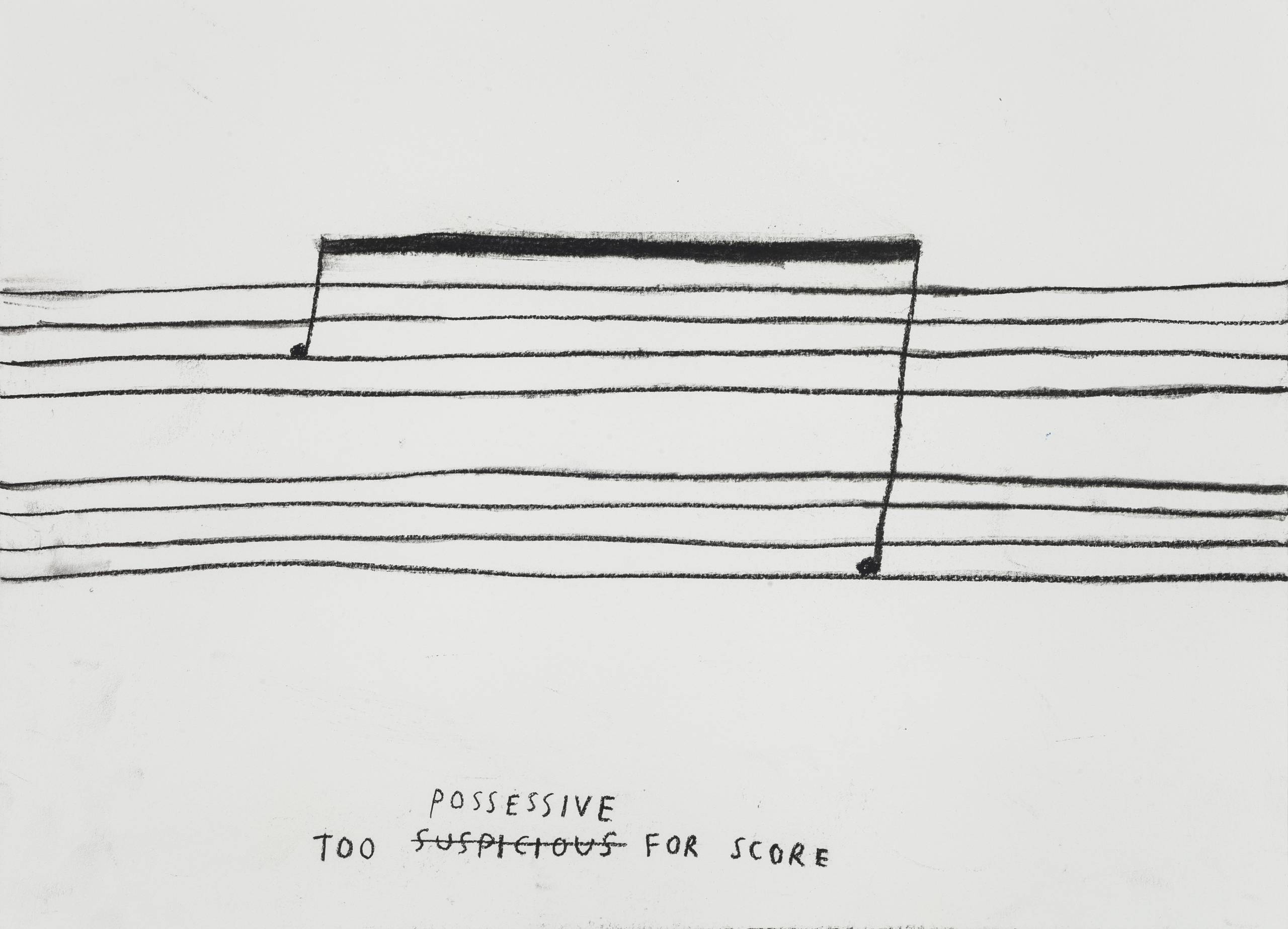
Christine Sun Kim, Too Possessive for Score, 2015. Private collection. Photo courtesy the artist, François Ghebaly Gallery, and WHITE SPACE.
Listen to verbal description:
Too Possessive for Score; 2015; Charcoal on paper; Private collection
Visual Description of Too Possessive for Score
Two sets of four closely spaced, parallel, black lines are hand drawn across the middle third of a horizontally oriented white sheet of paper to resemble musical staffs. The paper is 11 by 15 inches. Two widely spaced notes are connected by a thick black line that hovers over the upper staff. The first note sits on the third line down from the top of the upper staff, and the second note sits on the bottom line of the lower staff. Hand-written, all-capital text across the bottom reads, “Too Possessive for Score,” with “suspicious” crossed out and the word “possessive” written above.
Christine Sun Kim, Feedback Aftermath, 2012

Christine Sun Kim, Feedback Aftermath, 2012. Private collection. Photo courtesy the artist, François Ghebaly Gallery, and WHITE SPACE.
Listen to verbal description:
Feedback Aftermath is a marker and charcoal drawing on paper. It is rectangular, measuring almost 40 inches high, and 50 inches wide. The marks are fairly sparse, and are concentrated in the middle portion of the page. Near the top left, the words “FEEDBACK AFTERMATH” are lightly written in a small font, with all of the letters capitalized. Beneath this text, there are four thick black lines, made to look like a musical staff. The lines are hand-drawn, uneven in thickness, and slightly smudged. They contrast starkly with the white paper, and take up the center of the page. The staff lines stretch horizontally across the middle third of the page, running from the left side to the right edge. At the end of these lines, on the right side of the page, there are two additional, shorter sets of lines, as though the main staff has broken into separate, smaller staffs. Grey smudges of charcoal are scattered across the paper, and are especially concentrated near the lines, perhaps from the movement of the artist’s hand as the lines were being drawn.
Christine Sun Kim, Screen Real Estate for ASL Interpreters, 2022

Christine Sun Kim, Screen Real Estate for ASL Interpreters, 2022. Collection the Bohrer Family. Photo courtesy Christine Sun Kim, François Ghebaly Gallery, and WHITE SPACE.
Listen to verbal description:
Screen Real Estate for ASL Interpreters is a charcoal drawing on paper.
This drawing is a square, measuring about 45 inches on each side. On the top left of this work, Kim has written the title in bold, uppercase letters. The composition is dominated by a series of rectangles of varying sizes, each representing the amount of screen space allocated to American Sign Language interpreters in different scenarios. The lines of both the text and rectangles are slightly uneven, and the charcoal used in this drawing has left faint, wispy gray smudges in the negative space of this work. The rectangles are labeled with handwritten descriptions, offering specific examples of events or contexts where interpreters were allotted these portions of screen “real estate.” One small rectangle, in the top right corner of the paper, is labeled “NYC MAYOR DE BLASIO ON TWITTER”. Some of these rectangles overlap with each other, perhaps suggesting where the interpreters are positioned on a screen. On the left side of the paper, a long rectangle labeled “BLM PRESS CONFERENCES ON TV AND TWITTER” is partially obscured by another rectangle of a similar size, which seems to extend off the page. This rectangle is labeled “COVID PRESS CONFERENCE ON TV AND TWITTER”. At the bottom of the page, three distinct phrases appear in parentheses, slightly staggered. They read: “(2-10 SECONDS OF SELF-CONGRATULATORY FOR BEING ACCESSIBLE),” “(SEPARATE ASL FEED),” and “(‘WE FORGOT’ OFF-SCREEN)”. These represent responses Deaf people might encounter when trying to access American Sign Language interpretation, if any is given at all.